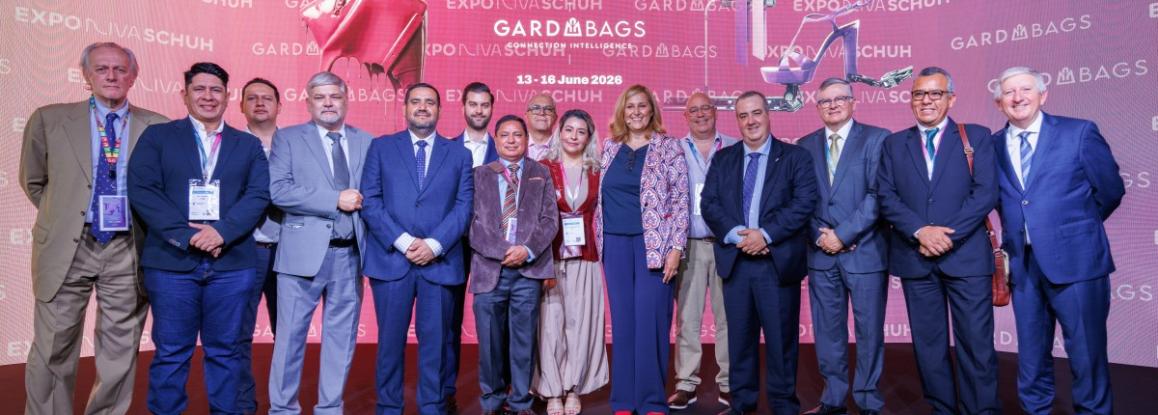
At Expo Riva Schuh and Gardabags, twelve national associations brought together by ACCAL highlighted the same obstacles: smuggling, counterfeiting, the sale of second-hand footwear and Asian imports diverted by the tariff war. The proposed solutions on the table include a regional common market, the EU-Mercosur agreement as a gateway to Europe, and production focused on leather, specialisation and small batches.
“We’re not taking any concrete solutions home with us. But we are taking an agenda.” Daniel Risafi, coordinator of ACCAL – Agrupación de Cámaras de Calzados de América Latina – brought the LATAM Footwear Leaders Summit on 13 June 2026,
hosted by Expo Riva Schuh and Gardabags, to a close with these words. Twelve national associations had laid out the problems and begun discussing possible solutions. A first step they decided to take in Riva del Garda. They chose the most important
international hub for the high-volume footwear market, and not only because Expo Riva Schuh and Gardabags could prove to be the platform for the global relaunch of Latin American footwear.
FOUR COMMON OBSTACLES
The diagnosis was identical from every side of the table: smuggling, counterfeiting, the sale of second-hand footwear, and imports from Asia. William Parrado, executive vice-president of ACICAM, added that Colombia faces the issue of extremely low import prices. Marcos Wong, president of GRECALZA, highlighted the combination of smuggling and second-hand goods as the main problem for Guatemala. Jorge Pérez, president of the Ecuadorian chamber CALTU, expanded the list to include trademark counterfeiting and a problem that is often overlooked from the outside: internal insecurity in certain countries. Héctor Antonio Ramos, speaking on behalf of the Salvadoran ASPCA, pointed out that opening up to Asian products had also been a government decision. Ricardo Espinoza, from Peru, put it as bluntly as possible: the influx of Asian footwear is hampering the sector’s growth.
Why now? The clearest explanation came from Arnaldo Ferreira, executive president of Abicalçados. The trade war between the United States and China has reduced US imports from Asia; Chinese production, the largest in the world, is seeking other outlets and finding them where consumption is growing. “Latin America, one of the major consumers of footwear, is facing this rise in imports.” Put another way: the region has not been hit because it is weak, but because it is attractive. This is a point to bear firmly in mind when formulating future strategies.
SPECIFIC CASES, GENERAL LESSONS
Not all countries are at the same point on the curve, and the two extremes deserve attention.
Chile has already made a choice in the past. Félix Halcartegaray, of FEDECCAL, outlined the figures for a fully open market: zero duty on Chinese products, 6% on Indian goods, and practically zero on European and Latin American goods. The result is a balance sheet with clear consequences: “The footwear industry used to employ 35,000 workers and today has fewer than 2,000.” Today, design work is carried out in Chile, but production has moved elsewhere.
Venezuela claims to be on the upswing. Tony Di Benedetto brought the first positive sign in years to the summit: “This year we have begun to see a small recovery. We had fallen quite a long way, but now we can glimpse the first signs of growth.” The key to further improvement lies in rethinking the continent’s domestic market.
And then there is Uruguay, whose situation epitomises that of many other countries: an expensive workforce, declining production, and work concentrated in niche sectors which — in the words of Alejandro Biasiolli, president of the Uruguayan chamber — are not enough to consider the sector in good health.
THE EUROPEAN DOOR
The European Union–Mercosur agreement is the new development that everyone at the table has been examining. Horacio Moschetto, president of the Argentine Chamber, described it as “a bridge, a direct link to European markets, which we know to be demanding”: consumers willing to pay for high-quality labour and the added value of materials – in other words, what Latin America is able to bring to the product.
Biasiolli added a note of caution: the market that is opening up is vast in both directions. “We must ensure that this market becomes permeable.” An opening only works if backed by a strategy — and for Uruguay, this means continuing along
the path already taken: sustainable footwear and leather traceability. Two requirements that are no longer optional in Europe.
WHAT LATIN AMERICA HAS TO OFFER
Two key areas for action emerged from the discussion to tackle and overcome the difficulties identified. The first is internal: a regional common market modelled on the European one. Ferreira put forward the economic argument in support of the continent’s potential leadership; indeed, ACCAL is the world’s second-largest manufacturing bloc and the GDP growth expected over the next two years exceeds that of other regions.
The second area concerns the product, and this is where the region has something that others lack. High-quality leather, first and foremost: Argentina focuses on high-end ranges; Ecuador on ISO- and INEN- certified footwear and the combination of design and comfort; and Guatemala on speed. Juan Carlos Cashat’s Mexico adds specialisation — Western-style boots in high demand in the United States — and an industrial model that Asian high-volume producers cannot replicate: fast deliveries and small minimum order quantities, in other words flexibility, a feature increasingly sought after by international customers.
None of these countries will ever win a price war. The point is that none of them are even trying to compete on price any more.
Risafi concluded the meeting with a prediction: “At the next editions of Expo Riva Schuh and Gardabags, you’ll see us participating in much greater numbers, perhaps with an ACCAL stand.”
So, see you at the 106th edition of Expo Riva Schuh and Gardabags, 16–19 January 2027. For an even more in-depth look at the Latin American footwear market.

