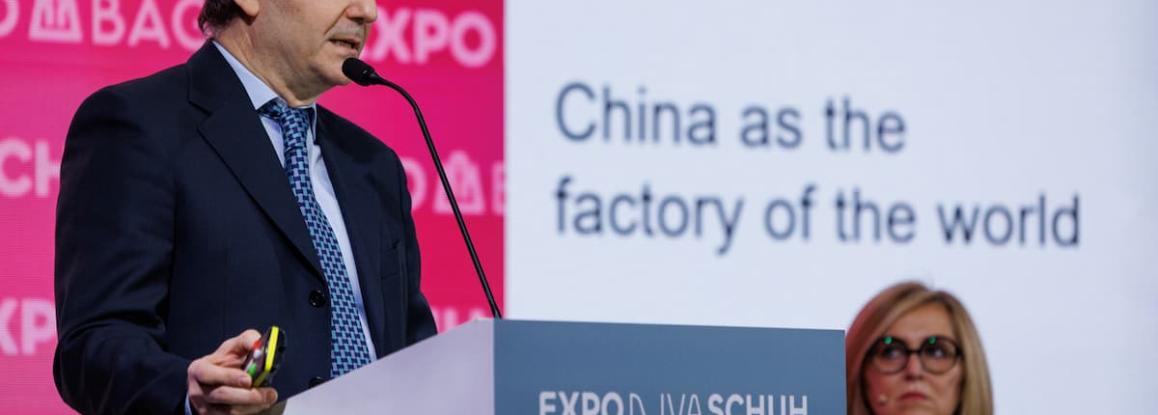
Enrico Cietta defines the future scenario as Affinity Globalisation: a model no longer driven solely by labour costs or production efficiency, but by a complex set of affinity-based factors.
Globalisation has not come to a halt. It is changing shape.
This was the starting point for the analysis by Enrico Cietta, economist and President of the Scientific Committee of Expo Riva Schuh and Gardabags, who outlined the key themes in his opening address at the event.
A DIFFERENT GLOBALISATION
Over the past twenty years, the global footwear and bag industry has operated according to an apparently stable pattern: on one hand the West, characterised by distribution and consumption; on the other, the south-eastern world, specialising in production. A model of globalisation that reached its peak between 2000 and 2020, creating the impression that it was definitive.
More recent events – from the pandemic to geopolitical tensions – have shown that this reading is no longer sufficient. We are not facing the end of globalisation, but the emergence of a new paradigm. A more complex model, shaped by a growing number of variables and less linear balances.
Cietta defines this new scenario as Affinity Globalisation: a model no longer driven solely by labour costs or production efficiency, but by a complex set of affinity-based factors. Geography remains important, but is now accompanied by geopolitical, cultural, technological and industrial elements and, above all, by a different approach to risk management (the pandemic has made everyone more cautious).
The pandemic marked a watershed. It clearly showed how fragile a supply chain concentrated in a single country can be, and just how strategic diversification truly is. This has led to a reorganisation of value chains that may resemble a process of regionalisation, but in reality extends well beyond a purely geographical concept. The “regions” of Affinity Globalisation are networks of relationships, not merely lines of proximity on a map.
THE ROLE OF CHINA
In this newly defined context, a long-standing assumption is now being called into question: China’s indefinite dominance in fashion-related manufacturing. The data show a progressive loss of share, both in terms of production and exports. From 2017 to today, China has lost around three percentage points of its share of global production, down to 54.3%, and more than five percentage points of its export share by volume, falling to 62% of the total. A temporary rebound in the post-pandemic period has not reversed the underlying trend.
The process becomes even clearer when analysing recent customs data. In 2025, Chinese footwear exports to the USA fell by almost 19 percentage points in quantity and nearly 25 percentage points in value compared with the previous year. For leather goods: –12% in volume; –22% in value.
By contrast, Chinese exports to other countries show a marked increase: Vietnam, Cambodia, Indonesia and Bangladesh.
This dynamic points to a growing dispersion of global footwear and leather goods production. Ever more countries are now joining supply chains, adding to the complexity of the system. A process that, rather than implying fragmentation, introduces redundancy along the supply chain.
It is also measurable through the global production dispersion index (HHI1 at 3,195 in 2024 compared with 3,314 in 2018), which indicates broader and less concentrated participation.
HOW SPHERES OF INFLUENCE AND CONSUMPTION ARE CHANGING
Alongside the theme of production, spheres of influence are also becoming a central issue. Historically, the system has been characterised by a clear separation between producer and exporting countries and consumer and importing countries. Today, this distinction is becoming increasingly blurred. Spheres of influence no longer strictly coincide with individual countries, but are articulated into broader aggregates within which the roles of production and consumption are beginning to overlap.
A clear signal emerges from the analysis of China’s competitiveness. Since 2017, the latter has experienced a net loss of approximately 783 million pairs in terms of exports and 766 million pairs in terms of production. Until 2022, China had been able to offset the reduction in exports through domestic consumption. From 2023–2024, however, this compensatory effect disappears: production and exports are now declining in tandem.
This shift signals a profound transformation of the Chinese domestic market, which is becoming less oriented towards pure replacement consumption and increasingly focused on higher value-added products. An evolution that affects not only the type of footwear demanded, but also the role of branding, design and the product's intangible content.
The issue of consumption becomes central when viewed in relation to population. Per-capita consumption data show that high population-density markets have significantly lower levels of individual consumption. In Europe, average consumption stands at around 5 pairs of shoes per person; in North America, at 5.9. In East Asia, this figure falls to 2.7, and in Central Asia to 2.0. The Middle East is an exception, with 4.1 pairs per capita.
This distribution reveals the existence of two distinct markets: on the one hand, replacement products; on the other, the “hybrid creative” product, in which footwear does not fulfil a merely practical function but also incorporates symbolic, aesthetic and cultural value. Over time, it is foreseeable that both types of consumption will coexist within the same spheres of influence, moving beyond the traditional opposition between the North and the south-eastern world.
THE CENTRAL ROLE OF EXPO RIVA SCHUH AND GARDABAGS
Within this complex scenario, Expo Riva Schuh and Gardabags position themselves as a working platform aligned with the new business model that is taking shape.
According to Cietta, there are two practical reasons for optimism. The first is the relational nature of the event: it is not uncommon for exhibitors to do business with one another, or for visitors and exhibitors to exchange roles. This reflects an ecosystem in which connections matter more than rigid divisions between clients and suppliers.
The second is the absence of a single flag. Expo Riva Schuh and Gardabags welcome different production systems and markets on an equal footing, reflecting the plurality of the global sector. This neutrality becomes a stabilising factor in an otherwise unstable context.
In a scenario of growing complexity, a challenge inevitably emerges. Today, an international trade fair must offer increasingly personalised services, building differentiated formats for different audiences. This is a process already under way – also reflected in the clear distinction between Expo Riva Schuh and Gardabags – and one that will continue in the years ahead.
Cietta’s final metaphor draws on sport: no one country can produce champions for decades – it will inevitably be overtaken by other nations – but it can build the stage on which all champions must compete and prove themselves. The Grand Slam tennis tournaments are a case in point.
This is the ambition of an event such as the one in Riva del Garda: to be a stable point of reference in a constantly evolving market, the global gateway for those who want to remain competitive in the world of footwear and bags.
NOTES:
1. The HHI index measures market concentration: a lower value indicates a lower concentration.

